Do Infrared Saunas Get Hot Enough?
Yes, infrared saunas get hot enough for a real sweat session. Cabins here top out between 135°F and 158°F, and that lower air temperature still warms your body directly, so you feel the heat without the sting of a traditional steam room.
On this page (10 sections)
- How hot do infrared saunas actually get?
- Why does an infrared sauna feel hotter than its thermometer?
- What temperature should you set for your first session?
- How long does it take to heat up?
- What's the difference between near, mid and far infrared?
- Is infrared heat safe at these temperatures?
- Which cabin gets hot enough for you?
- How do you get more heat out of your infrared sauna?
- How long will your infrared sauna stay this hot?
- So, do infrared saunas get hot enough?
Yes, infrared saunas get hot enough for a real sweat session. Cabins in this guide top out between 135°F and 158°F, and that lower air temperature still warms your body directly, so you feel the heat without the sting of a traditional steam room.
The confusion comes from comparing numbers. A traditional sauna reads 180°F to 200°F on the wall thermometer, while an infrared cabin reads 120°F to 150°F.
Both make you sweat; they just heat you in different ways.
How hot do infrared saunas actually get?
Infrared saunas reach about 120°F to 158°F depending on the model. That range covers the working temperatures of nearly every home cabin, from compact 1-person units to larger far-infrared rooms.
The Barcelona, a 1- to 2-person cabin, operates up to 135°F and recommends a comfort range of 115°F to 130°F. The Smart 3 Person far-infrared model goes higher, with an adjustable range from 120°F up to 158°F.
The 1-2 Person sauna with red light therapy lists a 150°F maximum.
Those numbers are air temperatures. Because infrared panels warm objects and people directly, the heat you feel on your skin runs warmer than the air around you.
That's why a 130°F infrared cabin can feel as intense as a much hotter traditional room.
Why does an infrared sauna feel hotter than its thermometer?
Infrared energy heats your body directly, so the air can stay cooler while you still sweat. The panels emit invisible light that penetrates skin and muscle, warming you from the inside rather than cooking the air.
A traditional sauna heats the room and the air transfers warmth to you. An infrared cabin heats you and the surfaces the light touches.
Your skin absorbs that energy and your core temperature rises, so you start sweating at a lower air reading.
This is also why infrared sessions feel gentler on the lungs. There's no steam to breathe and no blast of hot air when you open the door.
People who find traditional saunas stifling often prefer the deep, even warmth of infrared.
What temperature should you set for your first session?
Start at the low end, around 115°F to 120°F, and build up over several sessions. Beginners who jump straight to the maximum often feel lightheaded before they've had a chance to relax.
The Barcelona's maker recommends 115°F to 130°F as the comfort zone, which is a sensible starting band for most people. Spend 10 to 15 minutes at the low end and see how you feel.
If you're comfortable, raise the setting by 5°F to 10°F next time.
The red-light model suggests beginners start low and work up. Its timer runs from 1 to 99 minutes, with a recommended session of 10 to 15 minutes.
Short, repeated sessions teach you your own tolerance better than one long, hot one.
How long does it take to heat up?
Most cabins reach their working range in 20 to 40 minutes. Panel count, cabin size, insulation and the room's starting temperature all shift that number.
The Barcelona uses 6 dynamic low EMF carbon panels and the maker describes faster heat-up and energy-saving performance. Six panels in a 1- to 2-person cabin is a lot of heating surface for the space, which helps it climb quickly.
The red-light model also runs 6 large panels with 1450W of power.
The Smart 3 Person model has 8 far-infrared epoxy panels, and its WiFi control lets you preheat before you get home. That's the feature that matters most in winter: set it remotely, and the cabin is warm when you walk in.
What's the difference between near, mid and far infrared?
Far infrared is the type most home saunas use, because it penetrates deepest and feels warmest. Near and mid infrared sit closer to visible light and warm the skin surface more.
Far infrared waves are invisible light that the Barcelona's maker says penetrate up to 1.5 inches into muscle. That depth is what gives infrared its characteristic deep warmth.
It's also why far-infrared cabins are the standard for home use.
Red light is a separate feature that some cabins add. The Smart 3 Person model includes dual-band LED panels at 660nm red light and 850nm near-infrared light.
That's a light therapy layer on top of the far-infrared heat, not a replacement for it.
Is infrared heat safe at these temperatures?
Yes, at normal session lengths and settings. The cabins here use low-EMF heating panels and run well below the surface temperatures that cause burns in traditional saunas.
The safety rules are simple. Keep sessions to 10 to 30 minutes, drink water before and after, and step out if you feel dizzy.
The red-light model's maker notes to replenish water before and after a session, which is good advice for any cabin.
Don't treat an infrared sauna as a medical device. It's a comfort and relaxation tool.
If you have a heart condition, are pregnant, or take medication that affects sweating, ask your doctor before regular use.
Which cabin gets hot enough for you?
The right cabin depends on how hot you want to go and how much room you have. A 1- to 2-person model at 135°F suits most couples; a 3-person far-infrared cabin gives you a 158°F ceiling and more space.
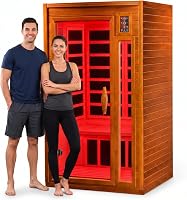
The Barcelona is the pick for most people. Its 6 carbon panels heat a compact 36 x 32 x 67 inch interior fast, and it runs on a standard 15-amp, 120-volt plug with no special wiring.
It assembles in about an hour on any indoor surface, including carpet.
If red light matters to you, the 1-2 Person sauna with red light therapy adds 7-color therapy lighting plus Bluetooth and radio. It reaches 150°F with a 1 to 99 minute timer and has 6 heating panels.
For families or anyone who wants the hottest option, the Smart 3 Person far-infrared cabin tops out at 158°F with 8 panels. It also offers WiFi app control for remote preheat.
It needs a 20-amp circuit, so confirm your household power first.
Who should pick the Barcelona?
Pick the Barcelona if you want a proven 1- to 2-person cabin with easy plug-in setup. It's the simplest path to a daily sauna habit without an electrician.
Its 135°F top end is lower than the far-infrared models, so it's not the choice if you crave a 158°F session. For most home users, though, the 115°F to 130°F band is where sessions actually feel good.
Who should pick the red-light model?
Pick the red-light model if chromotherapy lighting and music are part of why you want a sauna. The 7-color light and Bluetooth speakers make a session feel more like a spa.
Its 150°F maximum sits between the other two. The 40 x 36 x 73 inch footprint fits a small room or gym corner.
Who should pick the Smart 3 Person?
Pick the Smart 3 Person if you want the hottest cabin here and room to share it. The 158°F ceiling and 8 panels give you the most heat headroom of the three.
The WiFi preheat is the standout feature for anyone with a fixed schedule. Just budget for the 20-amp circuit before you commit.
How do you get more heat out of your infrared sauna?
Close the door, keep the vent shut, preheat longer and give the panels room to breathe. Small changes recover several degrees that leaks and drafts steal away.
The Smart 3 Person model has a built-in vent to keep air fresh. On cold days, close it during preheat and open it only if the cabin feels stuffy.
Don't block panels with towels or benches.
Our guide to how to get my infrared sauna hotter covers preheat timing, vent control and placement in detail. Before you buy, also check how much electricity a sauna uses, since higher settings and longer preheats draw more power.
And if you're weighing a steam option instead, read does a sauna need a water line first.
How long will your infrared sauna stay this hot?
A well-built cabin holds its heat for years, though panels and seals wear slowly. Most home infrared saunas run for a decade or more with basic care.
Wipe the interior after sessions and keep the door seal clean so heat doesn't escape. Our guide to how long do infrared saunas last covers panel life and what shortens it.
If your cabin takes longer to heat than it used to, a worn seal or dusty panel is the usual cause.
So, do infrared saunas get hot enough?
Yes. At 135°F to 158°F, they get hot enough for a deep, comfortable sweat, and the direct infrared warmth makes those numbers feel stronger than they read.
Pick the Barcelona for a simple plug-in 1- to 2-person cabin.
Pick the red-light model for chromotherapy and music. Pick the Smart 3 Person if you want the 158°F ceiling and remote preheat for a family-sized room.
Frequently asked questions
Is 135°F hot enough to sweat in an infrared sauna?
Yes. Infrared heats your body directly rather than the air, so 135°F feels warmer than the same air temperature in a dry room.
Most people start sweating within 10 to 15 minutes at that setting.
Why does my infrared sauna feel less hot than a gym steam room?
The air stays cooler because the panels warm your body, not the room. You'll feel a deep warmth on your skin and muscles while the air around you reads lower on a thermometer, which is the intended design.
Can infrared saunas reach 158°F?
Some can. Far-infrared models with more panels often top out around 158°F, while smaller 1- to 2-person cabins usually cap near 135°F.
Check the stated maximum before you buy if high heat matters to you.
Does a higher maximum temperature mean a better sauna?
Not always. A cabin that reaches 158°F gives you headroom for shorter, hotter sessions, but panel count, cabin size and insulation decide how fast it heats and how evenly.
A well-built 135°F model can beat a leaky 158°F one.